Across the country, schools are being asked to adopt evidence-based math instruction. The challenge is that while the term appears in legislation, state guidance, and curriculum reviews, there is far less agreement about what evidence-based actually looks like in a math classroom. As Education Week has noted, evidence-based math instruction is often less clearly defined than evidence-based practices in other subjects, leaving curriculum leaders to determine what meaningful implementation should look like in practice.
To better understand what the research points to and how it shows up in daily instruction, we sat down with Chris Coyne, Marshall Cavendish Education's National Education Consultant and a former teacher and elementary principal.
What the Research Points To
Ask a classroom of students what seven times eight is and many of them will tell you fifty-six without hesitation. Ask them why, and far fewer will have an answer.
Coyne describes how a student can reason their way to the answer instead. "You still have to figure out somehow what seven times eight is," he says. "Well, I know seven times seven... and then I just add seven more, because now I know what multiplication is. It's eight groups of seven instead of only seven groups of seven."
That reasoning reflects number sense, and Coyne says teachers are often surprised by how quickly it develops when students learn the underlying concept rather than relying solely on memorization. A student who has memorized a fact knows an answer. A student who understands the meaning of multiplication can reconstruct that answer independently whenever they need it.
"While automaticity is important, we don't want students just to memorize shortcuts or tricks," Coyne says. "We really want them to get the conceptual understanding."
Research increasingly points to the importance of balancing procedural fluency with conceptual understanding. Students need efficient strategies and automatic recall, but they also need to understand the mathematical relationships that make those strategies work.
The Concrete-Pictorial-Abstract Approach
One of the most well-supported practices in mathematics instruction is the Concrete-Pictorial-Abstract (CPA) approach.
Students begin in the concrete stage, working with objects they can physically manipulate, whether counters, fraction bars, coins, linking cubes, or other materials. They then move to the pictorial stage, where bar models, number bonds, diagrams, and other visual representations help them organize and represent their thinking. Only after those experiences do students work with abstract symbols, equations, and algorithms.
The sequence matters.
"Research shows that it really is beneficial to students when they use this with new concepts," Coyne says, because by the end of the progression "students understand where those formulas come from... it's not just memorizing."
Students are not merely learning procedures. They are connecting those procedures to the mathematical ideas that produce them.
CPA sits at the heart of the Singapore Math® methodology. Beginning in the 1980s, Singapore's Ministry of Education studied effective mathematics practices from around the world and integrated them into a coherent instructional approach designed to build deep mathematical understanding.
The concrete stage is also the easiest to skip.
"Sometimes teachers will jump over using manipulatives," Coyne says. "They'll jump over the concrete part and go right into the pictorial or even the abstract part."
Research consistently suggests that introducing new concepts at the abstract level alone is less effective. That is why Coyne considers manipulatives non-negotiable for many lessons. The encouraging reality is that most schools already own the materials they need. More often than not, those resources are already available somewhere in the building.
How Deliberate Variation Builds Understanding
Another research-supported principle is variation.
As students move through a chapter, problems often change in small but intentional ways. Those subtle shifts are doing far more instructional work than they may appear to be.
Coyne points to a lesson on factors, multiples, and prime numbers in a fourth-grade student book. One page shows chairs arranged in rows, and at first glance the task looks like counting. The next page shows the same chairs arranged differently, and a little further on the chairs become buttons, then a grid of squares.
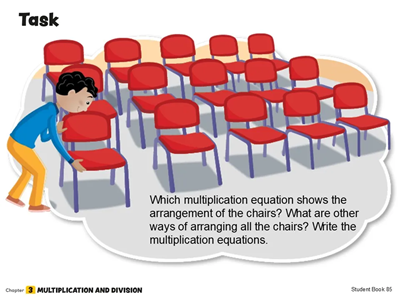
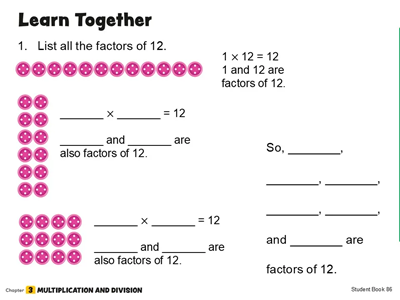

"We know that's fifteen, but how come five times three is fifteen?... The total number is the same, but it looks different," Coyne says. "And that's going to be important, because as it progresses we get into the area model of multiplication."
That grid is the same representation students will encounter later when learning to determine the area of a rectangle. By that point, they are not encountering a completely new idea.
"They can visualize it and think, 'Oh yeah, I remember when they were chairs,'" Coyne says.
As a result, length times width becomes the description of a familiar structure rather than an isolated formula to memorize.
To adults, the shift from chairs to buttons to grid paper can seem repetitive. For students, those carefully designed variations help build connections that make later concepts more accessible. What appears to be repetition is often the foundation for transfer and long-term understanding.
Catching Gaps at the Point of Use
A teacher who identifies a misunderstanding during instruction can often address it in minutes. A teacher who discovers the same misunderstanding on a chapter test may be facing weeks of reteaching.
Coyne describes a situation most teachers know well. "We can't wait until two weeks down the road. If we teach this lesson today and then two weeks down the road is the chapter test, and we realize that one, two, [or] the entire class is not doing well, I have to backtrack all the way for the last two weeks to see where things went wrong."
By then the problem has grown. "Those gaps will just snowball," he says, and they do not stay inside a single grade. A fourth-grade teacher who finds a student struggling with a third-grade concept cannot keep moving forward and hope it works itself out.
The alternative is formative assessment woven into the instruction itself. When a chapter opens by checking the prior knowledge the coming lessons depend on, a teacher learns what students may be missing before the new material starts, and can handle it on the spot rather than rebuilding two weeks of instruction. Coyne describes these as just-in-time, or point-of-use, resources.
That same structure supports learners across the achievement spectrum, providing reteaching opportunities for students who need additional support, grade-level practice for students progressing as expected, and extension opportunities for students ready to go deeper.
What This Asks of a Curriculum
These instructional practices are increasingly reflected in state policy expectations for assessment, intervention, and student support.
Kentucky's Numeracy Counts Act established a multi-tiered system of supports aimed at bringing students to grade-level performance by the end of grade five, and it asks districts to use a state-approved screener and to follow up with diagnostic assessment for students at risk. Maryland's PreK–12 mathematics policy requires districts to implement a Multi-Tiered System of Supports with tiered, data-driven instruction, and to make sure instruction is responsive for every learner, including those who need intervention, enrichment, or acceleration.
For school and district leaders evaluating mathematics programs against these expectations, several questions are worth asking:
-
Is the learning progression explicit enough that a screening result points to a specific instructional need?
-
Does assessment occur during instruction, or only at the end of a unit?
-
Do support resources already exist and align directly to the skills students may be missing?
-
Can a teacher who identifies a gap on Monday take meaningful action that same day or week?
A program can satisfy a screening requirement on paper and still leave teachers without a practical way to respond to what the data reveals. The most effective programs connect identification and intervention, allowing teachers to address learning needs in the moment rather than choosing between supporting students and staying on pace.
The Missing Ingredient: Teacher Mathematical Understanding
There is one part of this that no policy can deliver on its own.
"Teachers are a product of their own education system," Coyne says. "Often teachers don't understand the math themselves conceptually. They can do the math because they've memorized these rules or these tricks... so they can get through the math, but there's no understanding there. And if they don't understand it, how can they teach the kids to understand it?"
This is not a criticism of teachers. It is often a reflection of how many adults were taught mathematics themselves.
Several states have recognized this reality and invested in teacher development accordingly.
Alabama's Numeracy Act provides an instructional mathematics coach for every public elementary school and requires specialized training through the Alabama Math, Science, and Technology Initiative.
Texas House Bill 2, requires every K–3 math teacher, along with principals, assistant principals, mathematics instructional coaches, and interventionists at those campuses, to complete the Texas Mathematics Academy by the 2030–31 school year.
New Mexico's Senate Bill 29 requires six hours of mathematics methods coursework for elementary teacher licensure and directs the state to develop a mathematics instructional leadership framework supported by district professional learning plans.
These initiatives may receive less attention than screening mandates or intervention requirements, but they may ultimately have the greatest impact. Regardless of the curriculum a school adopts, teachers deserve opportunities to develop the same deep mathematical understanding we expect students to build.
That support is most effective when it is embedded directly within instructional materials through chapter overviews, lesson guidance, professional learning resources, and ongoing coaching.
The Bottom Line: Understanding Can Be Built
The research on how students develop mathematical understanding is more settled than the conversation around evidence-based instruction sometimes suggests.
For decades, Singapore's curriculum has incorporated instructional principles such as CPA, deliberate variation, and a strong emphasis on conceptual understanding. During that same period, Singaporean students have consistently performed at or near the top of international assessments such as TIMSS. While no single factor explains achievement outcomes, Singapore's experience demonstrates what is possible when evidence-based instructional principles are implemented coherently and consistently.
The mathematics taught in Singapore is not fundamentally different from the mathematics taught elsewhere. What differs is how students experience it.
For schools navigating new policy requirements, evaluating curriculum options, or looking for ways to improve student outcomes, the goal remains the same: helping students develop mathematical understanding that endures. When students understand the mathematics behind the procedures, they are better equipped to apply their learning in future grades, unfamiliar situations, and increasingly complex problems.
Want to see these principles in action? Explore a sample chapter of Primary Mathematics and see how conceptual understanding, CPA, deliberate variation, and formative assessment are integrated into daily instruction.
❝
❞
About Chris Coyne
Chris is a veteran educator with more than 20 years of service in K-8 education. He has taught at both the elementary and middle school levels in suburban and urban schools and has served as an elementary school principal. Chris has worked closely with schools, teachers, and administrators in Singapore and continues to collaborate with the Marshall Cavendish Education team in Singapore to develop and deliver professional learning focused on Singapore Math®.